Deeptech
Inria opens up the frontiers of innovation at Viva Technology 2023
Date:
14–17 June 2023

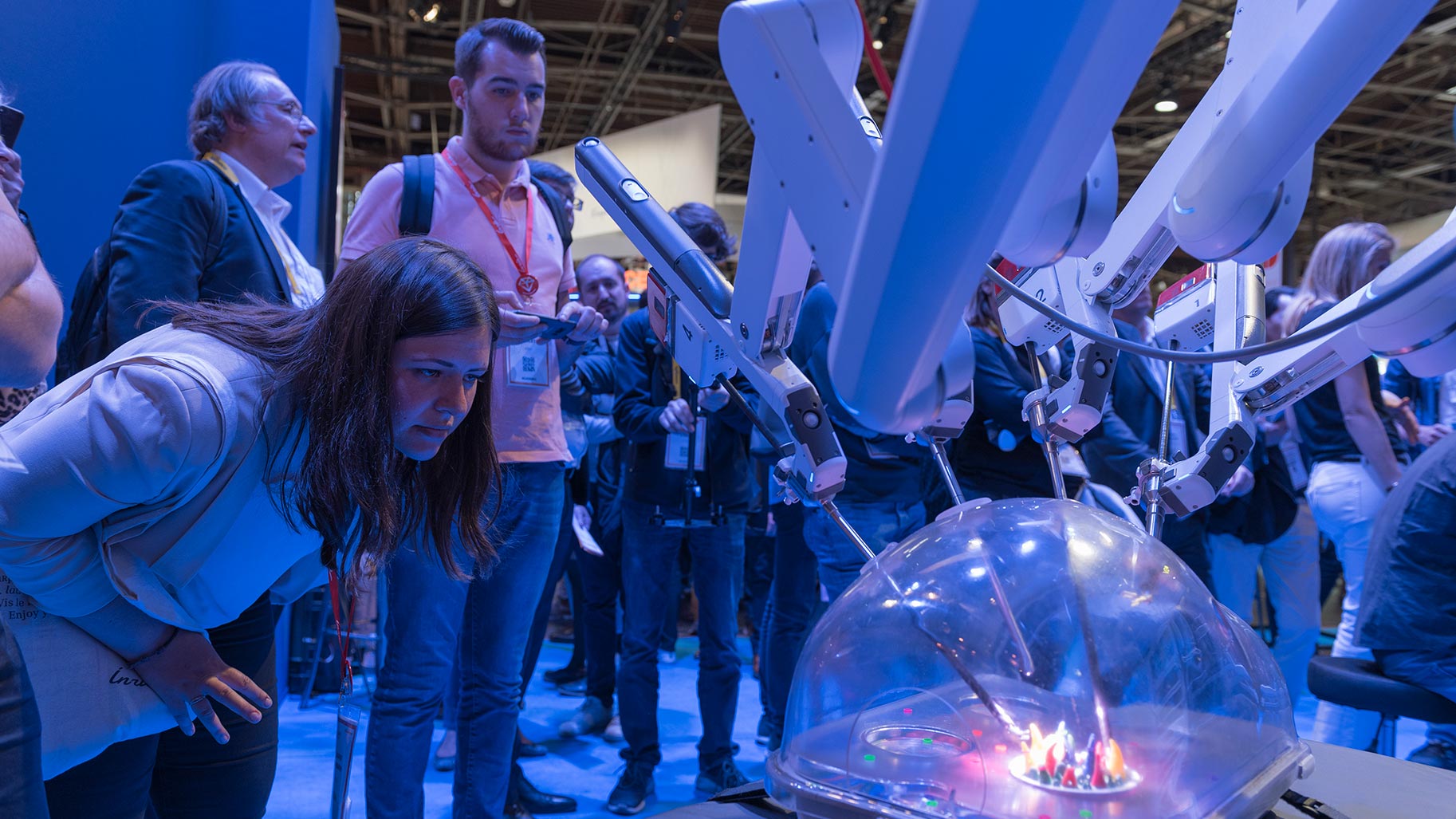
The Viva Technology meeting will take place from June 14 to 17, 2023 in Paris at the Paris Expo Porte de Versailles.
Presentations, pitches, debates and conferences bringing together the world of project teams and startups are to be discovered during these four days. Several Inria project teams and startups will be meeting professionals and the general public on the Inria stand and the Franco-German stand.
Enjoy an immersive experience on our stand dedicated to sports and digital technology: put your body and mind to the test in virtual or real reality, and follow your performance live with our researchers.
Future entrepreneurs will also be able to meet the project leaders supported by Inria Startup Studio, our digital entrepreneurship support program. Inria Startup Studio supports the project's development and helps it to become self-sufficient.
Cidre is looking at Windows malware traces to gain a better overview when analysing and modelling data using machine learning.
Nanophotonics is a science that studies the interactions between light and matter at the nanoscale, offering applications such as improved visualisation systems, integrated optical connections and innovative technologies such as photovoltaic cells and invisibility cloaks. The Atlantis team has developed DIOGENeS, a comprehensive software suite that enables the creation of a computational nanophotonics workflow, from the construction of the geometry to the optimisation of the structure, including the simulation of light propagation and the visualisation of the results.
Application software demonstration of tools for modelling the interface between two proteins and identifying the important amino acids. The case study concerns the complex form of the Spike protein of the SARS-Cov-2 virus.
Application software demonstration of tools for numerically solving optimal control problems. The fields of application considered include biology, agronomy, space mechanics and navigation, as well as more fundamental calculations related to Riemannian geometry.
Aramis uses pattern recognition to explore neuroimaging data using artificial intelligence (AI), in particular deep learning approaches.
Twinical harnesses the power of digital twins in soft tissue surgery to improve predictions and reduce errors.
Vocalia is a neural speech synthesis software solution for the media, publishers and the visually impaired.
Afoodi members seek to optimise restaurant profitability by reducing their carbon footprint, without constraints.
Poucet is a dedicated project for analysing user behaviour on web applications. This tool uses process mining and machine learning techniques to provide customised visualisations.
The MFX project team has designed the IceSL software for designing and preparing parts for 3D printing. This program contains unique features such as adaptive slicing optimisation, gradient filling patterns and colour 3D printing with filaments.
The DeepLipsync project is being led by the joint Inria - Loria MultiSpeech team. This technology is used to generate the animation needed to lip-synchronise 2D/3D avatars.
This work is behind the start-up Dynalips which offers a solution for animators of video games and animated series or films to help them save time and improve quality.
→ Discover the MultiSpeech team
The Makutu project simulations can be used to predict the behaviour of carbon dioxide, optimise the location of monitoring facilities and improve the safety and efficiency of CO2 storage operations. Combined with seismic monitoring techniques, these numerical simulations provide a comprehensive approach to effectively combating greenhouse gas emissions.
Aramis uses pattern recognition to explore neuroimaging data using artificial intelligence, in particular deep learning approaches.
Denergium helps companies improve the energy efficiency of their applications.
Sofa is a software package that uses computation to reproduce the physics of the world around us. This solution incorporates mathematical models and optimised algorithms to achieve real-time performance. This ability to efficiently simulate objects and their interactions has applications in a wide range of fields, including predictive medicine and robotics.
The Speech Privacy project is being led by the Inria Magnet project team and the joint Inria - Loria MultiSpeech team. It analyses the privacy risks associated with the use of voice assistants and illustrates the potential benefits of using anonymisation technology.
DeepLipsync est une technologie permettant de DeepLipsync is a technology for generating the animation needed to lip-sync a 3D avatar.
→ Discover the Magnet and MultiSpeech project teams
Created by Epione, Fed-BioMed is an open source research and development initiative aimed at translating federated learning into medical care. The application can, for example, train a model for segmenting 3D medical MRI images of the brain.
Willow's software solution multiplies the spatial resolution of smartphone camera images by four, i.e. up to 16 times more pixels! Useful for managing noise and loss of detail in dark or saturated areas in night photography, or for backlit portraits.
SILISPINE creates simulation tools to help practitioners diagnose back-related pathologies using digital twins.
COMPLIANCE ROBOTICS is developing a new generation of flexible robots. Unlike machine tools with articulated arms, this startup's robots transport objects safely with no risk of damage.
Operys reduces communication problems and errors on construction sites.
Zvote is a transparent electronic voting solution based on 10 years of CNRS and Inria research.
Pulse Audition helps people with hearing loss to perceive a voice clearly amid the surrounding noise.
QAIRNEL accelerates the advent of effective treatments for patients suffering from neurodegenerative diseases.
Stand opening in the presence of Bruno Sportisse, CEO Inria
"Digital Sovereignty" interview journalist Laura-Jane Gautier on Stage 2 (14h45) with Pierre Alliez and Philipp Slusallek.
"Depression, schizophrenia or bipolarity? How AI helps classify psychiatric disorders" - Inria/DFKI project.
Cybersecurity Startups pitch on the stand with Nijta and Skyld.
ARBOEL provides decision support tools in the form of SaaS software to financial market professionals.
Bringing brain-computer interfaces (BCIs) out of the lab and into the home - Inria/DFKI collaboration.
Skyld protects artificial intelligence algorithms against intrusions and reverse engineering.
Fintech Startups pitch on the stand with Arboel.
B2C & New Services start-up pitch on the DecorAR stand.
DecorAR was born out of the idea of being able to design your own home based on collected images. The solution learns from millions of images of interiors collected in trade magazines. Thanks to augmented reality, DecorAR will be able to render its knowledge of colour harmony and furniture choices to suit a given space.
How the world of research/academia supports deeptech entrepreneurship - Inria Startup Studio presentation.
Nijta works to protect privacy by securing voice data with voice anonymisation techniques.
With 500 days to go until the opening of the 2024 Olympic and Paralympic Games in Paris, Inria's teams are taking you into the world of games in both real and virtual environments. Today, nearly twenty of our project-teams are working on sports-related topics, from data collection and modelling to virtual reality. Get in touch with our research teams, measure your performance and feel the sensations of a sportsman or woman in full effort!
Location: Sportech Inria / Hall 2 : U18
Try your hand at a Virtual Reality (VR) training system that lets you face an attacker as if you were actually in a boxing ring! The system multiplies different types of attack, so that VR users can practise anticipating attacks without getting hurt. The MimeTIC team is taking part in this project with the M2S laboratory at Rennes 2 University.
To train a goalkeeper to make the right choices, the MimeTIC team, with the M2S laboratory at Rennes 2 University, is developing a Virtual Reality training system. In this demonstration, you will rehearse several shooting situations with precision! You will be equipped with sensors that allow you to reconstruct the movement of your avatar and thus quantify its performance in stopping the ball.
The ancestor of Basque pelota, this sport was originally played with the palm of the hand, then with a bevelled racket to help catch the ball on the bounce. Virtual reality controllers play the role of a racket, and a simulator is used to recreate the behaviour of the ball when it bounces off the walls or the racket. This project was made possible thanks to the work of the Hybrid team in collaboration with archaeologists and specialists from the 'Jeu de Paume'.
Location: Sportech Inria / Hall 2 : U18
The DIGISPORT university school offers a modular training programme based on educational innovation, hybridisation and interdisciplinary projects combining digital science and sport.